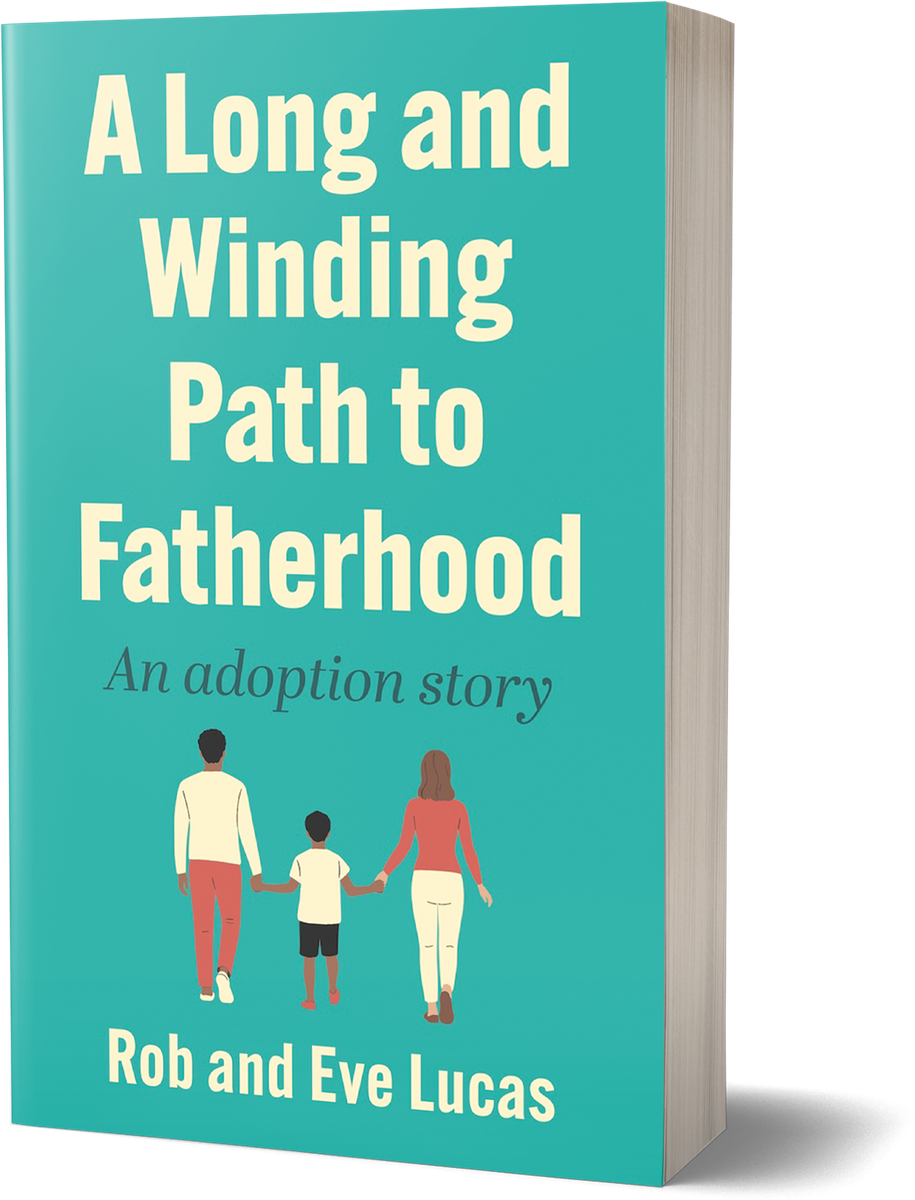

About the book
A seven-year journey to become a family
A Long and Winding Path to Fatherhood is the true story of how a husband and wife became parents to their adopted mixed-race son. Told from the male perspective, it is a heartfelt account of a seven-year journey through infertility, adoption, setbacks and finally, the life-changing moment of becoming Dad.
Raw, honest and hopeful, this is a story for anyone walking their own winding path to parenthood – and for those who believe that families are built in many beautiful ways
Key Themes

A male perspective on adoption
An honest, first-hand account sharing rarely heard experiences and emotions from an adoptive father

A mixed-race family story
Their story of how they completed their family by finding their mixed-race son through adoption

An honest and inspiring journey
From heartbreak and setbacks to laughter and joy – a story of perseverance, hope and finding their way

About the Authors
Rob & Eve Lucas
Rob Lucas is a passionate Arsenal supporter, an all-round sports fan, a keen walker and a dedicated Dad. He navigates a successful in career in finance with family life.
Eve Lucas is a writer, an event manager, an intrepid traveller and a devoted Mum which she combines with a burning desire to finish her first novel.
Contact us: [email protected]
From the Blog
The story continues...
The winding path of parenthood carries on
 Adoption Reflections
Letterbox contact: Why is it so hard?
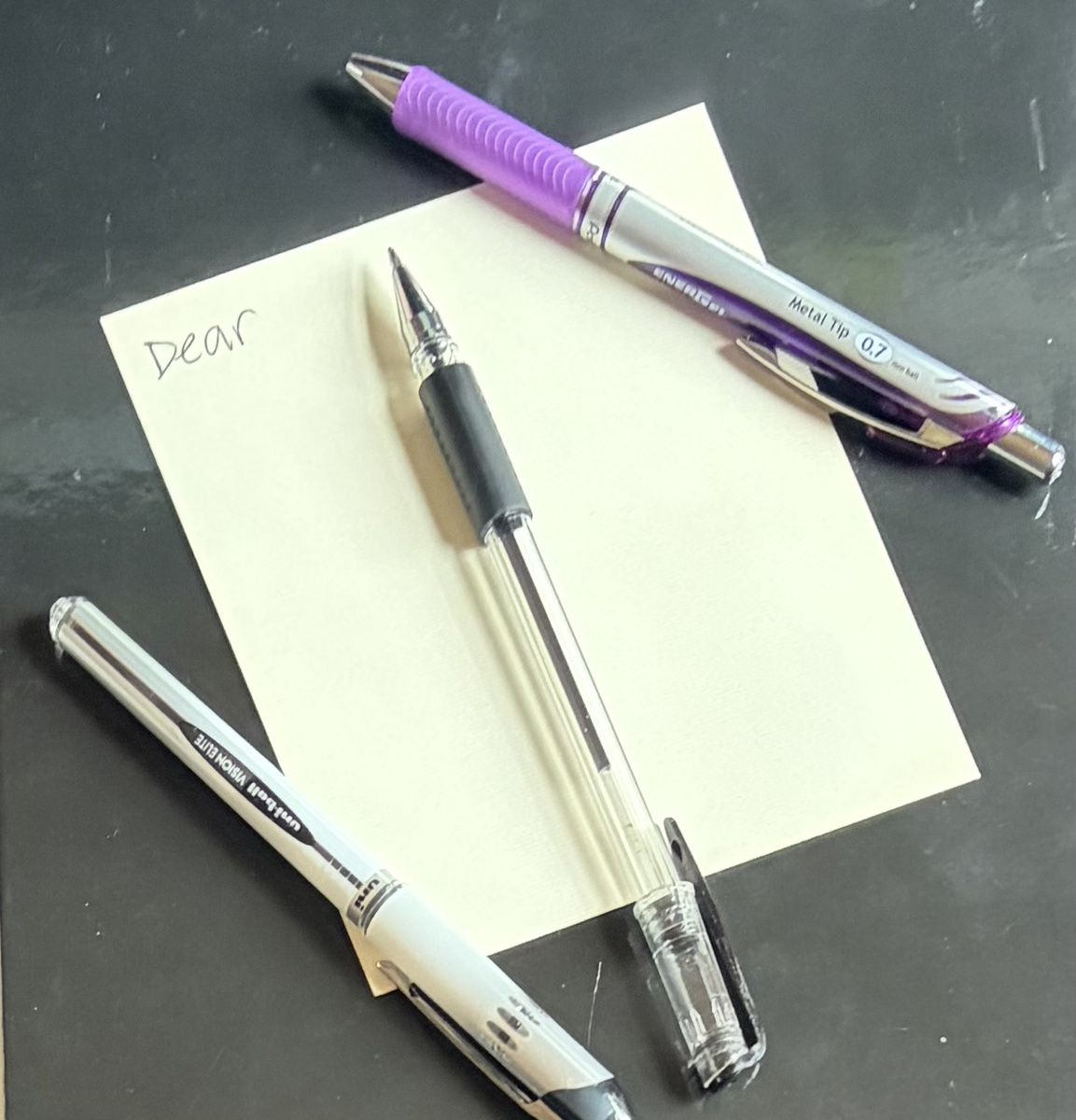
Letterbox is a part of most people’s adoption story. It’s the system which facilitates an exchange of letters and other things like drawings, photos and cards, between adopters and birth parents, on behalf of the adopted child. It’s administered by social workers, and fully anonymised.
For myself as an adoptive mum, it’s a twice-yearly commitment to write a letter and attempt to provide an update to our child’s birth family on how he’s doing, what he’s achieving, and generally that he is happy and healthy.
It’s a hard letter to write. Every single time. I battle with providing reassurance that he is well loved and taken care of, while not trying to suggest we are taking better care of him than they ever could. I share milestones in his life to let them know he is growing and developing well, while appreciating that this could also serve to highlight all that they are missing to those no longer in his day-to-day life.
In normal circumstances, I find it very easy to talk about my child, to tell everyone I know all about his latest foibles, games, obsessions and achievements. I am a proud parent, and share these kinds of things with almost everyone I talk to. But when it comes to sharing this information with the other people who love my child as much as we do, it enters another space.
To maintain the required level of confidentiality, no locations or dates or details at all are included, and so the whole thing lacks nuance, and the personal element. This all translates into a letter which often sounds to me like I’ve written it for a child, rather than simply about one. There is no room for humour or irony – and crucially, I came to realise when I interrogated why this letter is so difficult to write – any kind of connection between the writer and recipient. We have never met, and our only common ground is a child who is no longer the infant they remember, and we never knew our growing child to be.
To try and help with these letters, I have read around what birth families have said they enjoy hearing, or want to know more about. First and foremost, the consistent arrival of the letters confirms in itself that the recent news story they might have heard about the tragic accident suffered by, for example, an eight-and-a-half year old girl with red-gold hair is not their child. The prevailing thinking is that you can never say that the child is safe, well, taken care of and settled too many times, so this is something I start and end my letters with every time. In one article I read a birth mum noted that when she read the words “how are you?” in a letterbox letter she had felt that the writer really meant this as an enquiry and cared about the answer, so even though I have never met them, I made sure to include this kind of question and language in my next letter.
The letters sound repetitive though. As much as daily life with our son is ever-changing, sharing six months of updates and information turns out to be both daunting in its huge scope, and hard to pinpoint things of real importance and worthy of sharing when I sit down to do it. I’ve recently started to make a note of things I think will be good to include when they happen, to make sure I don’t forget them, and to give me a headstart on the next letter – even when it’s as much as five-and-a-half months away yet.
I also question myself about how much I am willing to give in these letters. Do I feel reticent to share too much, to truly share our child with them? In adoption, the fact that there are other people out there who love our child as their own as much as we do is the very starting point, and ever-present thereafter. But while they remain like shadowy, flat figures written about on forms, perhaps featuring in a few bad photos, its easier to push them to the fringes of busy family life. Once I’m writing a letter directly to them, they move closer and into the light. They take on the full three dimensions and become parents again, wanting nothing more than to know everything they possibly can about this child. It’s hard sometimes, as an adopter, to be selfless and generous with my child. After all, he’s my child. Not only my child, but I am his loving, protective, nurturing and caring mother. Being able to share that most important of roles with someone else is not easy.
By questioning myself about this though, I go back over the letters and ask myself if I could share a bit more here, bring this section alive a bit more with some further info, and try my very best to edit myself and challenge my own level of protectiveness as his parent. I’m not sure I am very successful at it, but at least I try. Maybe, just maybe, the next letter will come out sounding a bit less repetitive though, and perhaps even be a bit easier to write…
 Adoption Reflections
The book is out – now what?
A month has passed...
4 Aug 2026
Sunday 28 June 2026: the momentous date when our book, our story launched out into the big wide world!
Why was it a Sunday? I don’t know, my publishers told me that was the date, generated by an automated timeline I’m sure, and despite a few minor threats of delays all the deadlines were met and out it came, right on schedule.
The build-up was quite exciting. There were pre-orders by lovely friends and family across a range of booksellers – and countries too. There was the website creation and go-live, which I could then send to friends and family, and add to our social media profile. Seeing the ebook manuscript on my own Kindle and phone app was quite a moment too.
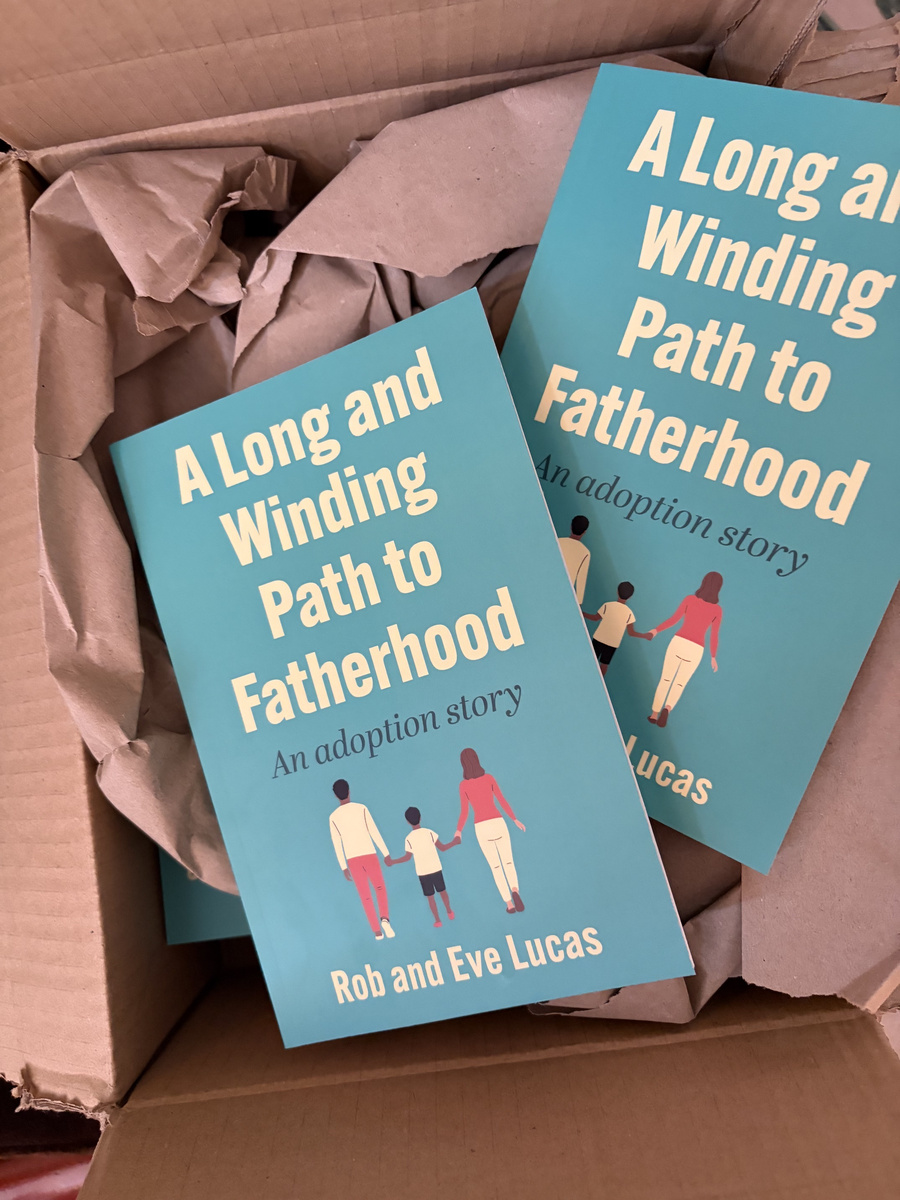
Then the boxes arrived…
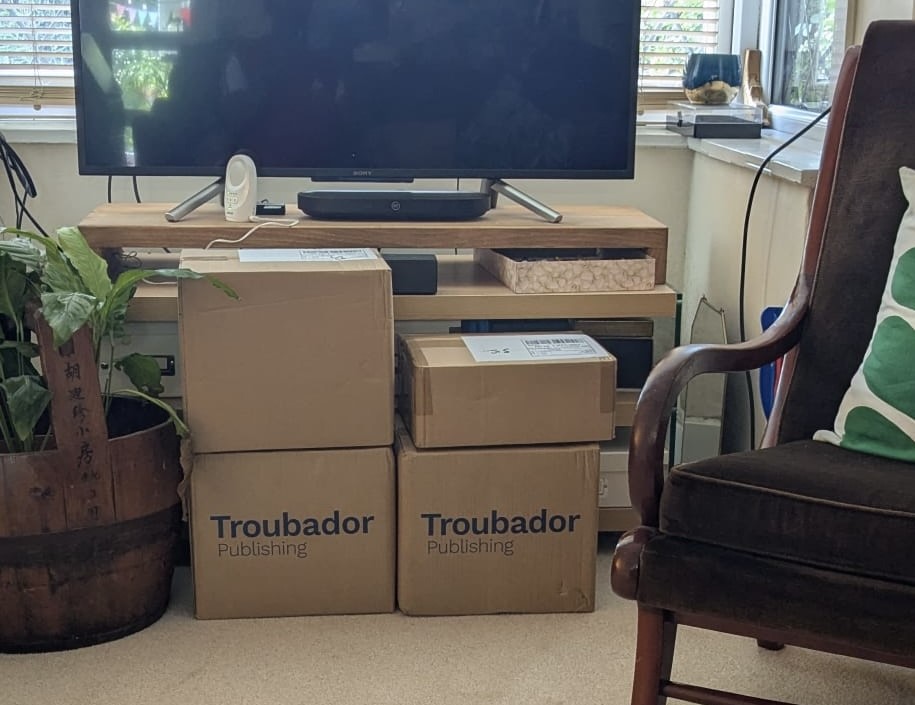
Our book, right here in our hands. It was quite a moment!
Watching our son pick up a copy, sit back on the sofa and flick through it was nothing short of magical. He was very concerned to make sure people knew that his name had been changed: he asked us to make sure his Grandad knew ‘about Marcus’. We assured him that everybody definitely knew this, and everybody we know who reads it will know that it’s him!
Once the book was available for instant purchase, we set about sending “book launch announcement” emails to adoption agencies and support organisations. This is one of our core audiences: professionals who work in adoption, who continue their reading and research and staying up to date with adoption narratives in all formats as part of the ongoing professional development.
Crucially, these individuals and their organisations also curate reading lists for wannabe adopters – the other half of our primary audience. If the agencies and organisations like it, they will recommend it, and this is definitely how we started our search when we wanted to know a bit more or felt we hadn’t read anything like this for a while.
It was a shot in the dark, sending messages out into the ether, and unlike social media we didn’t get to see or hear any tangible response in the short term. This made us think hard about our next round of communications…
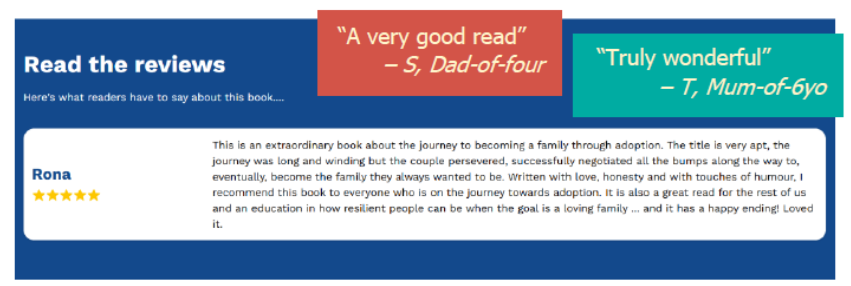
Then the reviews started to trickle in. Friends and family told us when they’d read it, and that they loved it! I mean, of course they said nice things. They weren’t going to say tell us they thought it was rubbish, were they?! It was heartwarming to receive their comments and compliments, and to get that slow-burn feeling that our story is out in the world now, in all its guts and glory.
As we’ve written this under pseudonyms, we aren’t having a big publicity-orientated launch campaign with parties and sales pushes. Interest in this kind of book is at best ‘niche’ and at worst very limited, so the usual advice to partner with your local bookshop and library and build a local writer profile don’t really apply. Seeing ‘only 4 copies in stock, more coming soon’ on the Amazon page was amazing. Until it moved to ‘only 5 copies in stock’, where it stayed.
And then – well, nothing.
It all just went quiet, only a few weeks – not even a month – after the big publication date.
Writer friends tell us that this is very normal, and their experience too. After all the months of frantic and time-sensitive work, and the joy of the book being printed and prepared and ready for everyone else, it does often all go quiet for a bit. And so we take solace from this at least. In a world where we are often wondering what is ‘normal’, apparently this is. So now we will put our energies into thinking about what’s next… and our next blog post too!
 Q&A
Q&AAuthors' Q&A
Get to know Eve and Rob a bit better…
Even though we write under pen names, it’s still very much two real-life people shining through in this book and as parents to a fabulous growing boy. If you’d like to learn a bit more about us, and how things have been going since the book left us, then read on…
Why did you write this book?
Rob: It came about because people around us had so many questions about adoption, about our application, about how it actually works, and seemed really fascinated by it. We didn’t know very much when we started out, and each time we talked to someone else about it we realised how much we had learned, worked through and discovered. We would like to share that feeling with others now.
Eve: It came out of reflection too, as we looked back over the last couple of years and recognised how far we had come. Writing it down, putting it all in order, re-visiting all those steps was a way of processing it all. Plus that realisation that a dad’s voice was one we had so rarely encountered, so we thought ‘why not?’.
What has been the biggest surprise / misconception about being adoptive parents so far?
Eve: That being an adoptive parent wouldn’t be as physical an experience as having been pregnant and given birth to our child. I thought that biology was responsible for ongoing hormonal reactions in the body as a parent, but it’s happened anyway. Our brains and bodies adapt and react to being around a child, and prioritising him. Even without a genetic tie…
What do you feel is the biggest difference between you and biological parents in your / Marcus’s friendship group?
Rob: We’ve been parents for 3 years less than all the others. Marcus’s development is exactly where it should be for his age, but as parents we are still lagging behind in some areas, like leaving him with other people for a night out together. We will get there, when we feel he’s ready. And we are too!
How do you handle telling outsiders that you are adopters?
Eve: My dentist recently commented that Marcus’s name was nice, and asked me why we chose it. I lied, which I try not to do generally, but this time I said “we just liked it” rather than the truth – which is that we didn’t have a choice. He came to us fully named and noisy and running and personality-filled. This wasn’t someone I felt the need to share more information with. In other situations, where I know the person better or I’m likely to do so in future, such as in a new job, I tend to be more upfront about it and just tell people early on. I don’t want it to be a secret, or whispered about behind my back. I’d rather just throw it out there. But Rob is still very reticent about sharing this information. Some things never change!